


Improving Clinical Workflow Using ILLUCO Dental Loupes
Discover how ILLUCO dental loupes improve clinical workflow, posture, and procedural accuracy. Evidence-based magnification solutions designed for Australian dentists, hygienists, and dental specialists.
Dentistry is one of the most visually demanding clinical professions in healthcare. It is also one of the most physically punishing. Australian research consistently shows that the great majority of dental professionals work with persistent musculoskeletal pain, pain that, in many cases, can be traced directly back to how they position themselves over the patient. A landmark Queensland study found that 87.2% of dentists reported at least one musculoskeletal symptom in the previous year, with neck pain affecting more than half. Among Australian dental hygienists, a separate 2013 study found that 85% report neck-related musculoskeletal disorders, with 70% reporting shoulder pain and 68% reporting lower back pain.
These are not minor career inconveniences. They are workflow problems with career-shortening consequences that include reduced productivity, increased sick leave, and in serious cases, early retirement. Yet the evidence is equally clear that the right magnification system can fundamentally change the equation. Properly fitted dental loupes don’t just improve what clinicians see; they restructure how clinicians work.
This article looks at how ILLUCO dental loupes improve clinical workflow across the four dimensions of posture, accuracy, efficiency, and longevity, and outlines how to choose the right ILLUCO loupe for your specific scope of practice.
The Workflow Problem: Why Dentists Strain
Without magnification, the dental working distance forces clinicians into a posture that is almost guaranteed to cause harm over time. To see fine detail in the oral cavity, the unaided eye needs to come close, which typically forces the neck into more than 20 degrees of flexion, often more than 45 degrees during certain procedures. Critically, even when loupes are worn, poor fit can undermine their protective effect. An observational study of dental hygiene students found that 100% of participants — all of whom were wearing magnification loupes — still exceeded the safe 20-degree neck flexion threshold at the conclusion of a 30-minute manual scaling task, with one-third in the harmful range above 45 degrees. The authors attributed this in part to inadequately fitted loupes, where working distance, declination angle, or frame size were not optimised. This finding underscores both points that follow: magnification is essential, and so is correct fitting.
Held repeatedly across an eight-hour clinical day, every day, this posture compresses cervical discs, fatigues the trapezius and rhomboids, and creates the chronic neck-shoulder-back pain pattern that dominates the Australian MSD data. Critically, the source of the problem is visual. The clinician is leaning in because they cannot otherwise see the field clearly. Stretching, ergonomic chairs, and posture training help around the edges, but they don’t address the cause.
What Loupes Actually Do for Workflow
Dental loupes solve the workflow problem by bringing the operating field to the clinician, rather than forcing the clinician to come to the field. With magnified and properly focused optics set at the correct working distance, the clinician can sit upright with the head in neutral or near-neutral position and still see anatomical detail with greater clarity than they could at close range with the naked eye.
The clinical literature on this is robust. A 2025 study published in Scientific Reports demonstrated significant postural improvements at the hip, trunk, head/neck, and shoulder regions when periodontology assistants used magnification loupes during supragingival scaling, though wrist posture did not change significantly. Hayes and colleagues separately found that magnification loupes reduce self-reported neck pain and disability among dental hygienists over time. Multiple systematic reviews have linked loupe use to improved operator posture, better preparation quality in restorative and endodontic procedures, and higher operator satisfaction.
In short: loupes don’t just magnify. They re-engineer the posture-vision relationship that has been quietly damaging dental careers for decades, provided the loupes themselves are correctly fitted to the individual clinician.
Beyond Posture: Three More Workflow Wins
1. Procedural accuracy
Cavity preparation margins, root canal orifice identification, subgingival calculus detection, and fissure sealing are all routinely performed more accurately under magnification. Systematic reviews of dental loupe use in tooth preparation consistently show improvements in preparation quality, with finer margin definition and reduced over-preparation. For students, the gains are particularly pronounced; for experienced clinicians, magnification reveals detail that simply cannot be resolved with the naked eye.
2. Procedural efficiency
Better visualisation means fewer second-guesses, fewer repositioning movements, and fewer instances of having to stop and re-examine. Across a clinical day this translates into more procedures completed without compromise on quality, a workflow benefit that compounds across weeks, months, and years of practice. Many clinicians report that they cannot return to operating without loupes once they have adapted to using them.
3. Career longevity
The combined effect of reduced neck flexion, less shoulder elevation, and reduced visual strain is a meaningful extension of comfortable working life. Musculoskeletal disorders are a leading cause of sick leave, reduced clinical hours, and premature retirement among dental professionals in Australia and internationally. Loupes do not eliminate this risk, but they are among the few interventions with consistent evidence of reducing it at the source.
The ILLUCO Loupe Range: Choosing the Right Tool
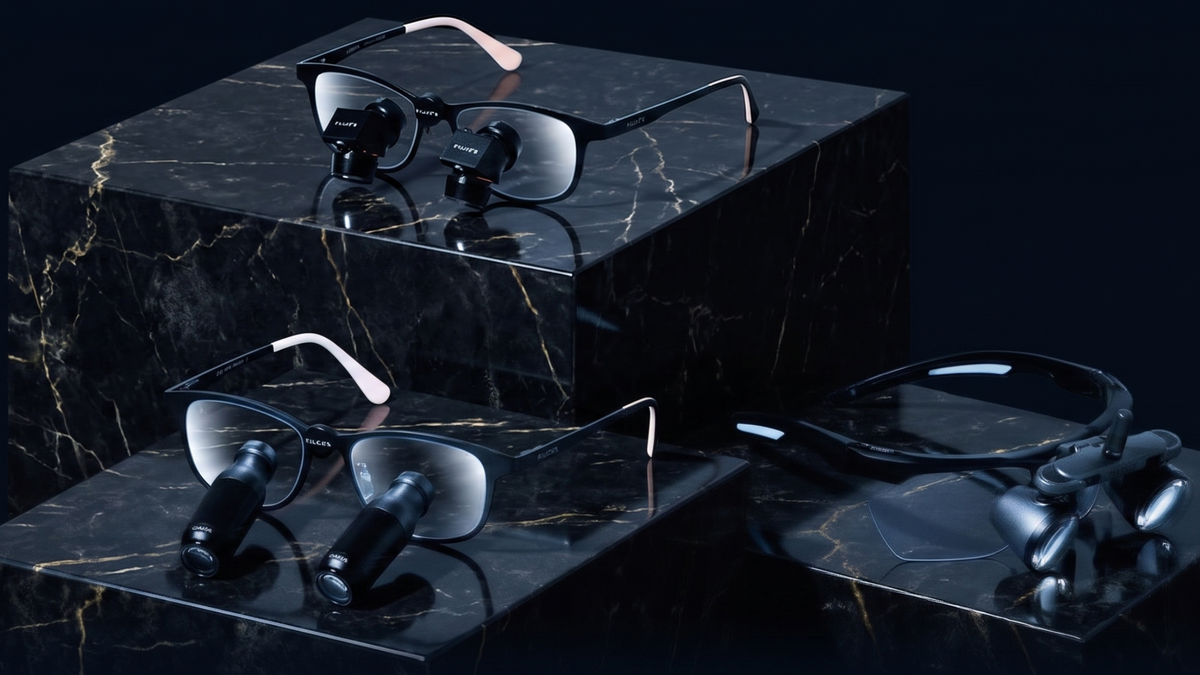
ILLUCO Australia offers four distinct loupe families, each engineered for a specific clinical use case. Choosing well depends on understanding what type of work you do, how many hours a day you spend at the chair, and how much magnification your procedures actually require.
ERGO X: The Angled Ergonomic Flagship
The ILLUCO ERGO X represents the latest generation of ergonomic dental loupes, with angled optics that allow clinicians to maintain a near-neutral head position even during procedures that traditionally demand significant cervical flexion. Comparative research indicates that angled (ergonomic) loupes reduce neck and back muscle loading versus standard through-the-lens (TTL) designs during extended scaling tasks.
The ERGO X delivers 3× or 4× magnification, and ILLUCO reports a 28% wider field of view and 20% greater depth of field versus comparable alternatives. Diopter adjustment, secure focus locking, and BBAR anti-reflection coatings combine to maximise light transmission and image clarity. For clinicians experiencing early signs of occupational neck or shoulder strain, ERGO X is the most directly therapeutic option in the ILLUCO range.
Prismatic Loupes for High-Magnification Specialists
For endodontists, prosthodontists, periodontists, and clinicians performing micro-detailed restorative work, the ILLUCO Prismatic Loupes deliver high magnification options ranging from 4.0× to 6.5×. Where Galilean loupes hit optical limitations at higher magnifications, the Prismatic range uses advanced prism technology to bend and refine light, maintaining a bright, clear, distortion-free image at magnifications where lesser systems lose depth and clarity. These are made-to-measure for each clinician.
Instant TTL Galilean Loupes: Ready-to-Wear Premium
The ILLUCO Instant TTL Loupes offer through-the-lens performance at standard magnifications (2.5×, 3.0×, 3.5×) without the wait time of custom-built optics. With telescopes mounted directly into the carrier lens, TTL loupes are lighter, give a wider field of view, and feel less obtrusive than flip-up alternatives. They are an excellent choice for general dental practice, hygienists, and clinicians who want premium optics in stock.
Flip-Up Loupes: Flexibility and Value
The ILLUCO Flip-Up Loupes provide an accessible entry into magnification at 3.0×, with the practical advantage that the optical assembly can be flipped up out of the field of view between procedures or for patient interaction. They suit clinicians who want the option to look around the loupes easily, who share equipment across operators, or who are building toward a higher-investment TTL or ERGO X system as their next step.
Pairing Loupes With ILLUCO Headlights
Loupes solve the magnification half of the visualisation equation. The other half is light. Overhead operatory lights are routinely blocked by the clinician’s own head or by the angle of the loupes themselves, producing shadowing that defeats the magnification advantage. The ILLUCO Wired and Wireless Headlights mount directly to the loupe frame, delivering bright, focused, shadow-free illumination exactly where the clinician is looking. For clinicians serious about clinical workflow, headlight pairing is not an upgrade. It is the completion of the system.
What to Expect When You Start
Adapting to loupes takes a short period of intentional practice, usually one to two weeks of consistent use before they feel like a natural extension of the visual workflow. New users should expect some initial reorientation as they learn to position the head, find the optical sweet spot, and trust the working distance rather than instinctively leaning in. Proper fitting at the point of purchase is essential, including interpupillary distance, working distance, and declination angle — the same three variables identified in the Stambaugh research as critical to whether loupes deliver their ergonomic benefit. ILLUCO Australia offers a structured fitting consultation, and clinicians considering loupes are encouraged to contact the team to discuss try-before-you-buy options available for their practice setting.
The Bottom Line for Australian Dental Practice
Australian dental professionals face an MSD prevalence that is among the highest of any clinical workforce. The evidence on dental loupes is equally striking. Properly fitted loupes improve posture, sharpen procedural accuracy, lift efficiency, and contribute to longer comfortable clinical careers. ILLUCO’s loupe range is engineered specifically for these workflow outcomes, from the ergonomically angled ERGO X to the high-magnification Prismatic, the in-stock Instant TTL, and the flexible Flip-Up.
Whichever model fits your practice, the decision to wear loupes and to have them fitted properly is one of the highest-leverage clinical investments a dental professional can make, not just for what you see in a single procedure, but for the shape of your entire career.


