


The Optical Engineering Behind ILLUCO Dental and Surgical Loupes
How ILLUCO engineers its dental and surgical loupes, from Galilean and prismatic optics to working distance, depth of field and the angled ERGO X design.
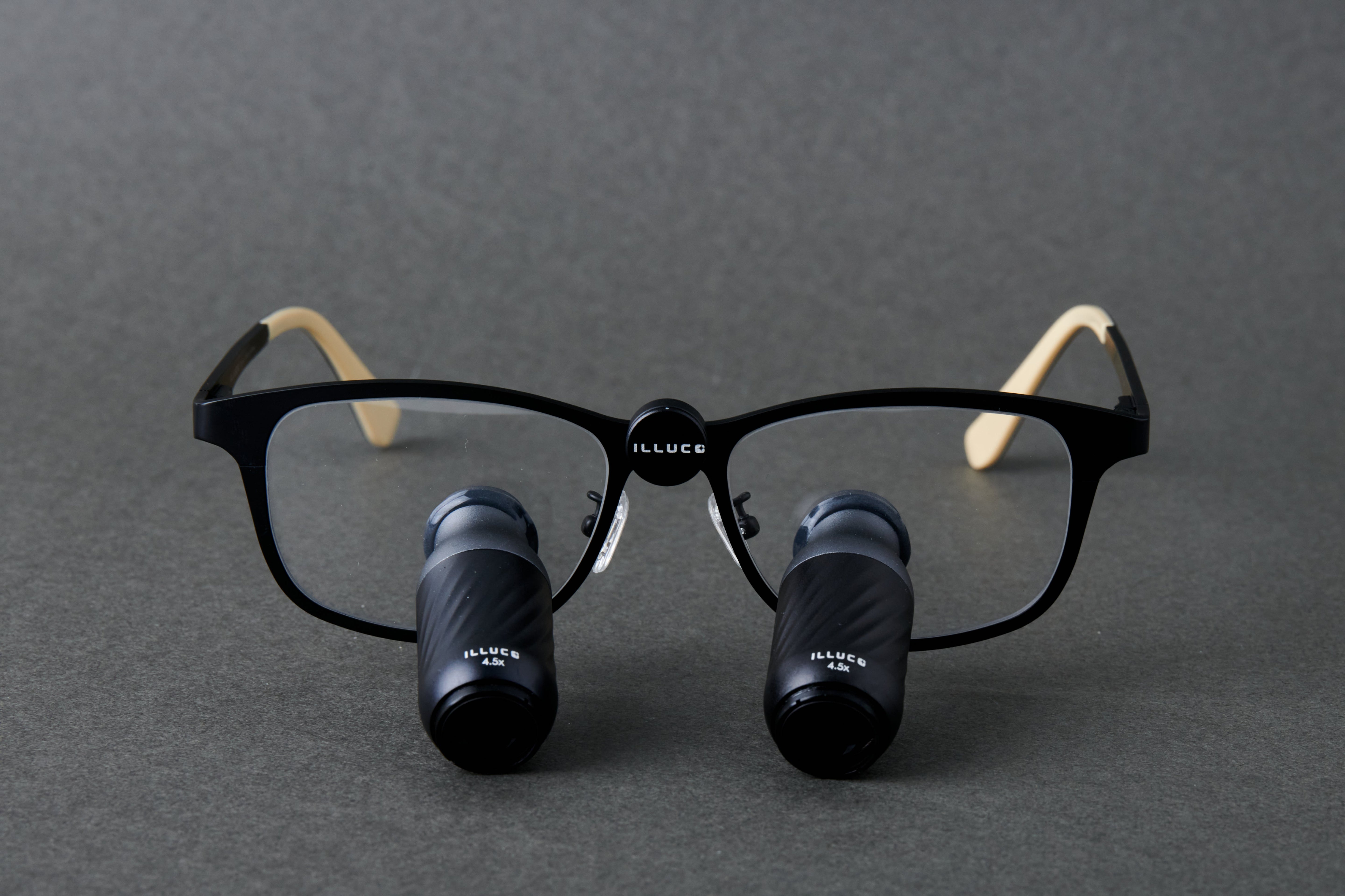
Loupes look simple from the outside, a pair of small telescopes mounted on a frame. The engineering inside them is anything but. Every curve of glass, every prism angle and every coating is a deliberate trade-off between magnification, clarity, field of view, weight and comfort. Get the balance right and a clinician sees more detail, sits straighter and works longer without fatigue. Get it wrong and the loupes end up in a drawer.
ILLUCO designs and manufactures its optics in-house in Korea, and that background shows in the detail of the lens systems, prism assemblies and frame geometry. This article looks at the optical engineering behind the ILLUCO loupe range, what actually happens to the light between the working field and your eye, and why those choices matter at the chairside and in theatre.
How a loupe magnifies: two optical systems
At heart, a loupe is a compact telescope, and there are two ways to build one. ILLUCO uses both, matched to the magnification and the type of work.
Galilean optics
A Galilean system, used in ILLUCO's Galilean and Instant loupes, pairs a convex and a concave lens to enlarge the image. It is light because the light travels in a straight line through relatively few elements. That simplicity keeps weight down and, at a given magnification, tends to deliver a wider field of view and a deeper depth of field than a more complex design. The trade-off is a practical ceiling on magnification, since pushing a Galilean system too far softens the edges of the image. This is why ILLUCO offers Galilean optics in the lower to mid range, around two and a half to three and a half times.
Prismatic (Keplerian) optics
For higher magnification, ILLUCO uses a prismatic, or Keplerian, design. Here, prisms are added to the lens train to fold the light path and correct the image. Folding the light lets the system reach much higher magnification in a manageable length, and the extra optical control produces a crisp, bright, distortion-free image. The ILLUCO Prismatic loupes sit at the top of the range for magnification and detail, typically around four to six times. The cost of that power is weight, because prisms and additional lenses add mass, and at the same magnification a prismatic system usually shows a slightly narrower field of view and shallower depth of field than a Galilean one.
The table below sets the two systems side by side. For a fuller comparison, ILLUCO has a dedicated guide on prismatic versus Galilean loupes.
|
Feature |
Galilean |
Prismatic (Keplerian) |
|
Optical design |
Convex and concave lenses in a straight path |
Lenses plus prisms that fold the light path |
|
Typical magnification |
Lower to mid, about 2.5x to 3.5x |
Higher, about 4x to 6x |
|
Field of view |
Wider at a given magnification |
Narrower at a given magnification |
|
Depth of field |
Deeper, fewer refocus movements |
Shallower, more refocus movements |
|
Weight |
Lighter |
Heavier |
|
Best suited to |
General clinical and hygiene work |
Fine, detail-heavy procedures |
The measurements that define good optics
Magnification is only one number on the spec sheet. Several others matter just as much for real clinical use.
Working distance
Working distance is the gap between your eyes and the field when the image is in focus. It is set at the design stage and cannot be changed afterwards, which is why ILLUCO measures each clinician before manufacturing. Too short and you hunch forward, too long and fine detail suffers. A correctly set working distance is the foundation of both sharp vision and good posture, and it is a core part of the loupe fitting process.
Depth of field
Depth of field is the range of distances that stay acceptably sharp without refocusing. A generous depth of field lets you move your head slightly, or work across a curved surface, without the image blurring. It is one reason lower-magnification Galilean loupes can feel easier to work with across a long list.
Field of view
Field of view is how much of the working area you can see at once. A wider field means less head movement and easier orientation, while a narrow field concentrates on fine detail. Higher magnification always narrows the field, which is part of why the strongest option is not automatically the best one.
Resolution and lens coatings
Resolution is the loupe’s ability to render fine detail, and it depends on the quality of the glass, the precision of the lens curves and the coatings applied to them. Anti-reflective and multi-layer coatings cut internal glare and light loss, so more of the available light reaches your eye as a clean, high-contrast image. This is where in-house optical manufacturing earns its keep, since coating quality and lens tolerances are decided on the production line rather than in the marketing copy.
Declination angle and the ergonomics of optics
Optical engineering does not stop at the glass. The angle at which the scopes point downward, the declination angle, decides how far you must tilt your head to look through them. A steeper, well-designed declination lets you keep your head close to upright while your eyes drop to the field, which protects the neck over a career. It matters because the published evidence links magnification loupes to improved working posture and relief of shoulder, arm and hand strain.
ILLUCO's ERGO X takes this furthest. It uses a prism-based angled design with a steep, roughly sixty-nine degree declination angle to allow a notably more upright posture, alongside a wider field of view, a deeper depth of field and a built-in diopter adjustment. Recognised with international design awards, it is the clearest example in the range of optics and ergonomics being engineered together.
Through-the-lens or flip-up mounting
How the optics attach to the frame is its own engineering decision. Through-the-lens loupes set the scopes directly into the carrier lens, custom-aligned to your pupillary distance and line of sight. Because the optics sit closer to the eye and move with your head, they give the widest usable field, the lightest feel and no optical drift, at the cost of being fixed to one wearer. Flip-up loupes mount the scopes on a hinged bar in front of the frame, so they can be flipped out of the way and adjusted more freely, which suits clinicians who want flexibility or a first pair without a formal fitting.
How ILLUCO engineers its loupes
Two things separate a well-engineered loupe from a generic one, the optics themselves and the fit. ILLUCO controls both. The optics are designed and manufactured in-house, backed by patents and international design awards. Each pair is then built to the individual, with pupillary distance, working distance and magnification measured before manufacturing, so the finished loupe matches the wearer’s eyes and posture from the first day.
The result across the range, from lightweight Galilean loupes to high-magnification prismatic optics and the angled ERGO X, is a consistent philosophy. Match the optical system to the task, set the working distance and declination to the clinician, and use coating and lens quality to keep the image bright and sharp.
Choosing the right optics for your work
The best loupe is the one matched to how you work, not the one with the biggest number on the box. If you value a wide, forgiving field and light weight for general and hygiene work, a Galilean design is often ideal. If your work is fine and detail-driven, prismatic optics repay the extra weight. If posture is your priority, an angled design such as ERGO X puts ergonomics first without giving up optical quality.
ILLUCO measures and fits every pair, so the simplest way to find the right combination is to talk it through. Book a consultation and the team can match the optics, magnification and fit to your clinical work.
This article is general information and is not a substitute for a professional fitting or individual clinical advice.


